It’s pouring rain outside and I’m about to go to bed. Time for a little hillbilly history—let’s talk about Harmonica Frank Floyd.
“Harmonica Frank,” as he was known, is one of those mysterious and elusive characters in musical history, known primarily for his association with Sun Records in Sam Phillips’s earliest phase of his iconic Memphis record label. Harmonica Frank recorded at Sun Studios first in 1951, which yielded two singles leased to Chess Records in Chicago. In 1954, Sam Phillips released one Harmonica Frank release on the Sun label, shortly before releasing a record by a young, good-looking kid named Elvis Presley. And with Presley’s quick ascent to fame and fortune, Harmonica Frank’s career was tossed out with yesterday’s newspapers.
It’s a bit odd that Sam Phillips saw any commercial appeal in Harmonica Frank’s music to begin with. It was hillbilly, but it was also blues. It was rough music, the kind you’d hear by itinerant performers on street corners, not the kind of music you’d hear in performance halls or even beer joints that featured live music. Frank was already old by the time he wandered into Sam Phillips’s studio. His music came from old sources: vaudeville, hokum, jug bands, and medicine shows. Whatever vision Sam saw in Frank’s mixture of hillbilly and blues music was quickly overshadowed by Elvis Presley’s commercial appeal to teenagers, and it’s a bit of a miracle that Frank was ever allowed to make records at all. His releases on Chess and Sun sold so poorly that today, the known existing copies can be counted in the dozens, not even hundreds.
Frank Floyd was born in 1908 to sharecroppers in Mississippi, who split up before giving him a name. His name was registered as “Shankles Floyd” in the 1910 census. I’ve absorbed unusual hillbilly names all my life, but “Shankles” really takes the cake. The boy without parents was raised by wolves, essentially—he found himself traveling with medicine shows and carnivals, teaching himself to play harmonica and guitar and entertain a crowd, which is what he did for the rest of his time on the Earth. He taught himself to play harmonica without the use of a harmonica holder, and sang out of one side of his mouth while holding the harmonica in the other side. While this method worked for him, it also made his vocals extremely garbled and strange sounding. He also taught himself to play harmonica with his nose, enabling him to play two harmonicas at one time. His guitar playing was rough as a cob, with elements of both hillbilly and blues jumping out in jagged accompaniment to his harmonica playing. In 1951, when Sam Phillips first recorded him, Harmonica Frank was already something of a fascinating musical freak show, a throwback to a time long ago that had disappeared.
The great writer Nick Tosches wrote this about Harmonica Frank:
“You’re lucky you’re not from where Frank Floyd was from. I’m not talking about Toccopola in Lafayette County, Mississippi, where he was born, in the fall of 1908. I’m not talking about the backwoods of Arkansas, where he grew up before heading out on his own as a sapling boy, in 1922, to make his nightly homes in roadside ditches throughout the South. I’m talking about somewhere beyond place and time. I’m talking about nowhere. I’m talking about where the shades of the dead do their danse macabre and pass their jars of jake and meths to the living who have been drawn into the realm of those shades. You’re lucky you’re not from there. You’re lucky that Harmonica Frank Floyd—current age: deceased—can take you there, can let you come and leave there at will. But you’re lucky you’re not from there.”
Greil Marcus interviewed and wrote extensively about Harmonica Frank in his book Mystery Train:
“What matters about Frank is the sense of freedom he brought to his music: a good-natured contempt for conventional patterns of life combined with a genius for transforming all that was smug and polite into absurdity. The result was a music of staggering weirdness, dimly anchored by the fatalism of the blues and powered by the pure delight of what was soon to be called rock ’n’ roll. Frank wasn’t sexy, like the rockabilly singers who were to make Sam Phillips’s fortune; he was more like a dirty old man. He was ribald, and he had a flair. “I am,” he growled in one of his numbers, “a howling tomcat.”
Harmonica Frank’s record on Sun, “Rockin’ Chair Daddy,” backed with “The Great Medical Menagerist,” was reviewed in Billboard in mid-1954: “This side is an unusual mixture of R&B and country music. The singer is a country artist, instrumentation is the type used for downhome blues wax.”
It was this mixture of hillbilly and blues that Sam Phillips would also see in young Elvis Presley. Just a few days after Harmonica Frank’s “Rockin’ Chair Daddy” was released to little or no fanfare, Elvis’s “That’s All Right” / ”Blue Moon of Kentucky” was released and immediately began making noise around Memphis. And when girls caught sight of Elvis Presley, a mania began that propelled this weird mixture of hillbilly and blues music to the top of the national music charts; bringing it out of the Deep South into homes all over North America and beyond.
Years later, when Hank Davis and Colin Escott interviewed Harmonica Frank, he asked them in an innocent, childlike voice: “Is it true? Did I make the first rock and roll record?” Davis and Escott couldn’t tell him no, but they couldn’t say yes, either. The truth was a lot more complex.
Harmonica Frank Floyd, the man born with no name, spoke of sleeping in ditches, never spending more than two nights in one place for a thirty-five-year stretch. His world was not the same as the world of Elvis or the Beatles. There were no limousines, there were no screaming teenage girls, there were no perks at all. Just a ditch to sleep in, and if he was lucky, a few dollars and an ass-pocket of whiskey to knock him out and forget how cruel the real world could be. We can’t even conceive of the world he lived in. You and I could go out in that Mississippi heat and sleep in the ditches for a few nights, but we’d have thirty-five years left to go before we could have an idea of what Frank Floyd’s time on the planet was like.
Surely there must have been other performers like him, but by the 1950s (and through the decades to the 1980s, when Frank finally passed in 1984), he was something like a weird ghost of the past, somehow still performing his primitive southern medicine show music for anybody who would listen. Frank was “rediscovered” by musicologists and played many folk festivals during the 1970s and 1980s—cash only, no musicians’ union, he insisted—and made several live recordings, all of which sound like a bizarre time machine back to the old, weird America. Primitive, wild, nutty, funny, scary, not for the faint-hearted.
My friend Allen Larman, whose parents Roz and Howard Larman produced the Folk Scene radio show for forty-six years, got to see and meet Harmonica Frank at a folk festival in Los Angeles in the early 1970s, when he was a young kid. “He scared the shit out of me,” Allen told me. “I had never met anybody like that before. He was a real hillbilly peckerwood.” (Allen, forgive me if that wasn’t your exact quote, but it was pretty close.)
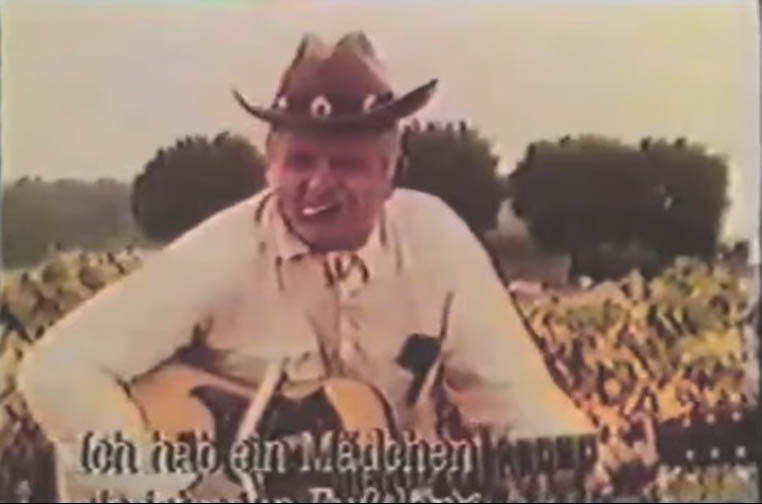
During this time period, the only known video footage of Harmonica Frank performing live was filmed by a German documentary crew. If you haven’t heard Harmonica Frank Floyd before, be forewarned: this is weapons-grade weird stuff. Nobody said the real stuff was pretty. The real stuff cuts deep, deeper than any publicist could ever dream, deeper than the radio would ever dare play. The real stuff, quite simply, is supposed to scare the crap out of you. There will never be an AI version of Harmonica Frank Floyd, because the robots couldn’t dream up a character that weird. Watch the video. You’re welcome.